Showing posts with label Seasonal. Show all posts

Thursday, October 24, 2013

Haunted Landscapes

     In true Halloween spirit, I decided to let my 6th graders have a little bit of fun this season.  Usually I save all of the holiday themed projects for my younger kids and keep the older kids working on things like value, perspective, art history, and the like.  Now, don't get me wrong, all of these things are VERY important in an art lesson and some could say that the elements and principles of art are the foundation to everything we do.  I could not agree more.  However, 6th graders are kids, too, and they deserve to make a Halloween project just like the rest of them.
     So, we painted the background first using red, yellow, and orange paint to create the sunset.  Next, I showed them how to cut out the shape of a house and fold the paper to cut out the windows (believe it or not, some kids didn't know this little trick!).  For the details like bats, trees, and so on, we used sharpie markers.  It would have been a tad too tedious to make the kids cut out the tree silhouettes and the small details.  Hope you find some inspiration you can use in your lessons!


Friday, April 26, 2013

3-D Paper Rainbows

Is this not THE MOST ADORABLE art project you have EVER seen?  (Ok, I get a bit overly excited about rainbows, lol).  This was a project I did with my Kinders yesterday.  We sorted the paper strips, compared the sizes, ordered them from least to greatest, and used patterning.  Whew!  Let me say, it did take the entire hour of art class for these creations, but it was worth it!  You start with an 18" red strip and decrease the size by 1.5" for each color until you end with the pink strip.  Doing this, it causes the paper to bend into that fabulous arc.  You should definitely give this project a try!


Wednesday, March 20, 2013

Handprint Rainbows

Here in STL, we are not even close to Spring weather and I cannot take another minute of 20 degree temperatures, so we are bringing Spring into the building with flowers, bees, and RAINBOWS!  What says 'elementary art' other than a rainbow painting?  Nothing.  I did this project with my 2nd graders and they did a great job.  I wouldn't go any lower than that unless you have some really great Kg. & 1st graders who have self-control, can handle a mess, and have exceptional listening skills.

First, we drew some clouds and colored the 'negative space' with the blue crayon for sky.  Next, I went around and lightly drew a big arc on their paper so they had a guideline to follow for the handprints.  I demonstrated how to press (not slam, slap or tap) their hand into the puddle of paint and carefully stamp their hand on the arc, wipe off the paint with a paper towel, and stamp the next color.  Of course, we had to discuss ROYGBIV and the color spectrum so they knew what order to print their colors.  The results were great, but I have to say...I probably won't be doing this again until NEXT Spring.  It was a lot of prep work and a LOT of clean-up!  Hahaha.


Monday, January 14, 2013

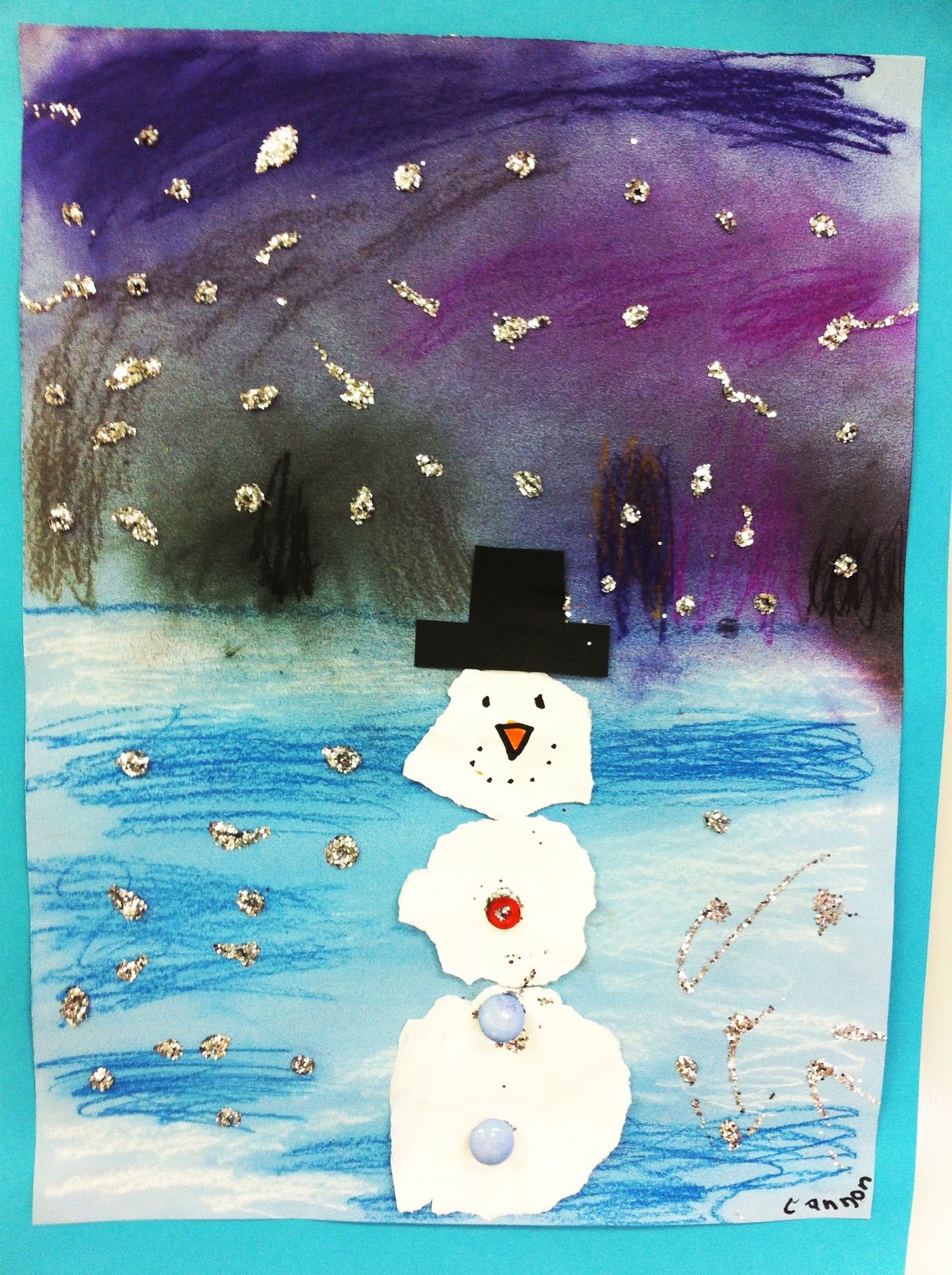
Torn Paper Snowmen

This is the second year that I've done this project with my 2nd graders (which is rare due to the fact that I hardly ever repeat art lessons).  Once a year, on a very good day, when I have lots of energy for clean-up, I bring out the chalk pastels.  For this project, we used shades of blues, purples, whites, and grays to create a nighttime winter scene.  I introduce them to the 'horizon line' to divide the sky from the ground.  We color the snow with white & light blue first so our fingers are still moderately clean.  Then, we use dark colors for the sky.  After we are all washed-up and clean, we use white paper to tear three different sizes of circles...1 small, 1 medium, & 1 large.  We talk about the texture of torn paper resembling the fluffy, soft snow.  And lastly, we add buttons to the snow people and dots of glue for the glittery snow! Here are a few great examples:


Friday, December 14, 2012

Snowflake Collages

     I really love projects involving snowflakes because of the technical, mathematical aspect.  Now, I will admit the ONLY mathematical theories that I enjoy are those involving symmetry and shapes...that's it!  So, to introduce this lesson, we always begin with an overview of symmetry and rotational symmetry.  By this point in the year, 3rd-6th graders are pretty familiar with the concept of symmetry so I'm basically just reinforcing what they already know and giving them a hands-on approach to further stretch their knowledge on the subject.  I showed the class several different examples of snowflake designs that I found on the ever-handy Google Images.  Next, I passed out strips of paper that measure 6" long and 1/2" wide.  They are encouraged to start the snowflake by gluing strips of paper in an X and putting one or two more strips of paper through the middle of the X both horizontally and vertically.  Now the fun begins.  I show them how to cut the strips into little pieces to add details to their snowflakes.  I reinforce that each line has to be the SAME in order for the snowflake to remain SYMMETRICAL.  Here are a few great examples from 4th grade:

 By Mary Jane

By Gabby

Thursday, December 13, 2012

Penguins!

     It's getting COLD here in the Midwest...finally.  We've had a very nice and mild fall and I am hoping for snow!!!  One way to wish the sparkling white stuff upon us is to incorporate it into our artwork.  First, let me apologize for neglecting you for so many weeks.  I got out of the habit of blogging and before I even realized it, I had let more than a month slip by without posting.  I have to admit, however, that Pinterest has taken over my life.  It's been so very helpful organizing my art lesson plans.  I just pull up the image of the artwork, type out my objective, put it on my projector, and away we go.  I promise to keep up with my posting here, as well, for all of my faithful followers (if there are any of you left, lol).

     This is a version of a collage that we made last year.  I did this with my 2nd graders this year.  We watched a few You Tube videos on Penguins to get us inspired.  Next, we cut out the shapes to make the body, wings, & earmuffs.  Lastly, we painted snowflakes falling on our paper with white paint.

Here are a few great examples:

By Anna Rose 

By Marvella 

By Lauren


Thursday, January 19, 2012

Metallic Winter Trees

I know tree silhouettes tend to be overdone from time to time.  But...I just think they're beautiful!  I also think they are one of the most simple things to draw with the most beautiful results.  So, I gave each one of my 6th graders a 6x8" piece of paper and showed them how using line variations and overlapping the lines can be quite easy.  Next, the amazing part came.  I let them each use a SILVER MARKER!  They were very excited and tried extra hard so their drawings would turn out just beautiful.  After we colored in the trees & added falling snow, the students used watercolor right over the marker drawings.  I told them they could 1 color + black so it looked like nighttime.  Here are a few examples:

 India's Tree

 Christopher's Tree

 Alex's Tree


Gabe's Tree

Tuesday, January 17, 2012

Penguins, Polar Bears, & Snowmen!

Well, it finally decided to look like winter here in the Midwest.  So, what better way to ring in the season than to make some winter animals!  I got this adorable lesson from Mrs. Haake over at Apex Art, http://apexart.blogspot.com/2012_01_01_archive.html.

I loved all of the bright colors!  After 2 classes of penguins, however, I needed to mix-it up and add some other creatures.  So, we used the same concept of cutting specific shapes by making Polar Bears & Snowpeople.  To make the lesson go smoothly, I had pre-cut paper at each student's seat.  For example, I had the 10x10 background, a 9x9 white or black paper (depending on the animal), colorful 3x3 squares for the earmuffs, & strips of colored paper for the scarves.

Here are some of my student examples:


 Kennedy's Penguin - 2nd Grade

 Grace's Penguin - 3rd Grade
Destiny's Polar Bear - 2nd Grade

 Caleb's Snowman - 3rd Grade

Martha's Snowman - 3rd Grade

Friday, December 2, 2011

Paper Ornaments/Spheres


This is a lesson that I did with my 5th and 6th graders today.  They were SOOOOO excited to begin the project because I had two spheres already made and they look very cool.  But as we were working, they realized just how complicated these are to make.  It takes some patience, but with a little bit of good direction, your students will be making these in no time.  We made the large spheres but if you wanted to conserve paper and call them 'ornaments', then I suggest making the medium or small ones.  All three templates are located on the blog I listed below.  Here are a few tips when working with students:
1.  Use words like 'floor' 'walls' and 'ceiling' and reference constructing a house.  This helps them to understand that the walls need to attach not only to the floor, but also to each other.
2.  When cutting out the shapes and the cutting lines, have the students hold the template on the paper to get a precise cut otherwise the pieces won't attach correctly.
3.  I had them start with 6 pieces and construct the 'floor' and the 5 'walls' first so they got the main idea of the construction.  Then, when they got the hang of it, I gave them the last 6 pieces of paper.
4.  This will take more than one class period to finish.
5.  Good Luck!!

http://howaboutorange.blogspot.com/2011/11/how-to-make-3d-paper-ball-ornaments.html

Wednesday, November 30, 2011

Construction Paper Pine Trees

I am reposting this project from last year.  If you are like me...you are swamped with demands for backdrops, hallway decor, holiday programs, and much more!!!!  I do this project every year because I just LOVE the results and I know that you will too.

This project works great for grades 2-6.  First of all, we discuss the shape of an evergreen tree in it's 2-D form (if we were drawing it).  Then we discuss the 3-D form of a triangle...the cone.  Next, I demonstrate how to make a cone out of green construction paper, make 'fringe' on the edges to resemble pine needles, and stack cones in various sizes to make the tree taller.   Lastly, I make a mixture of white paint, glue, and water and let the kids splatter some snow and glitter on top of their trees.

Tuesday, November 15, 2011

Ceramic Leaves

These beautiful ceramic leaves have been hanging in our foyer for the past several weeks.  I finally decided I should photograph them and share them with you.  First of all, I have done this project for the past several years, but never have they turned out this beautifully...and I have to admit it was by pure accident.  My sixth graders made these leaves one day in art by pressing a real leaf into their clay to create the texture.  They cut out the shape of the leaf while it was pressed into the clay.  After they dried, I bisque-fired them and had them ready for the surface treatment.  In the past, I have used black glaze to fill in the veins and the texture with a colored glaze on top.  But, with budget cuts, I am in short supply of glazes this year.  So, I had the students use black acrylic paint to fill in the veins and wipe off the surface with a damp sponge so the paint only goes into the texture.  Next, I had the students use watercolor paint to add color.  This is where the "happy accident" comes in.  When the watercolor was first applied, it looked nice...a suggestion of color...not too vibrant.  But, when it dried, it looked like mud!  Chalky-mud!  So, I was going to have the students repaint them until I tried putting a gold glaze on top of the watercolors.  And, voila!  It made the color come to life while adding a shimmer of gold.  Perfect!!!


Friday, October 14, 2011

Oil Pastel/Chalk Pastel Pumpkin Drawings

3rd graders yesterday afternoon learned about depth perception and overlapping while creating these spooky pumpkins.  I like the effect of chalk on dark paper, so we started with a blue sheet of paper.  The students drew the first pumpkin with an oil pastel right in the middle.  Next, they drew the two side pumpkins a little bit smaller and behind the first one to show depth and overlapping.  They colored inside the spaces with chalk pastels (VERY messy, btw) and cleaned up their drawing by re-tracing the oil pastel lines.  Here are a few completed works of art:

Mary Jane's Pumpkins

Grace's Pumpkins
Devan's Pumpkins

Thursday, October 13, 2011

Pointillism Pumpkins

2nd graders this afternoon created these perfectly plump pointillized pumpkins!  We looked at the art of Georges Seurat and took special note of his use of dots in his painting techniques.  We used several colors instead of just one color to fill up the spaces in our pumpkins like Seurat did in his paintings.

 Isaiah's Pumpkin

Aaron's Pumpkin

 Cameron's Pumpkin

Tuesday, October 11, 2011

Tree Silhouettes

My amazing 6th graders created these beautiful paper tree silhouettes.  I showed them how to use the Portfolio water soluble oil pastels by drawing on their paper using lines that express rhythm and movement and spreading the color around their paper with a wet paintbrush.  We talked about the color wheel and which colors will mix well together and which ones will look like 'mud' when mixed.  The students chose what time of day they wanted to depict and which colors would best represent that particular time of day.  While their paper was drying, we started to draw the trees.  This is a difficult task to draw branches using lines that overlap, show thickness/thinness, and are connected together.  Here are some of the finished projects:


Friday, October 7, 2011

Fall Landscape Reflections

For this project, I must have been hopped up on caffeine to be able to complete it in the allotted hour time-frame.  First of all, I had to set out oil pastels, watercolors, watercolor brushes, acrylic paint, acrylic brushes, and paper towels for each student...whew.  But, the results are so stunning, I felt like it was well worth the extra effort on my part.  Here were the steps:
1.  Fold the paper to create the horizon.  2. Draw the clouds with the white oil pastel, the tree trunks with the brown oil pastel, and the water waves with the blue oil pastel.  3. Use watercolor paint to paint the sky and the water.  4.  Use the acrylic paint to 'dab' the foliage on the trees.  5.  Re-fold the paper to make the reflection in the water.  6.  Use a slightly wet watercolor brush to make short horizontal brushstrokes in the reflection to make it look like water.

I worked while the students did so they could follow one step at a time and see how quickly they needed to work to move on to the next step.  Here are some finished paintings:

 Zalyn's Landscape

Tyler's Landscape

Ra'jai's Landscape

 Kayla's Landscape

Wednesday, October 5, 2011

Construction Paper Owls

For second grade art today, we made owls using different sizes of pre-cut squares.  I showed them how to cut a triangle out of a square by tilting their scissors from the bottom corners and cutting to the top of the square.  This was a VERY difficult task for 2nd graders, so I had to draw the diagram on the board so they could use a crayon to draw the lines and then cut out the triangles.

We started with one triangle pointing up at the bottom and overlapping each row of triangles as we added more to shape the body of the owl.  Next, I showed them how to cut circles from squares by cutting off the corners until they have a circle.  We cut out three different sizes of circles and overlapped them to make the eyes.

I had planned on doing this with my Kg. class as well, but after seeing how difficult this was for 2nd graders, I changed my plans!  

Amauria's Owl

Aliyah L.'s Owl


Rodney's Owl

Wednesday, September 28, 2011

Scarecrows!

This is an adorable lesson that keeps the primary artists busy for the entire class period!  I break it up into steps for the students to follow along to ensure success for everyone.  Here are the steps:

1.  Trace and cut-out the shapes for the scarecrow's shirt, pants, & hat using stencils and wallpaper scraps (set aside for later).
2.  Discuss farmlands (the crops, colors, and lines).  Draw the hills using curved lines and show the students how to repeat that same curved line in each hill to represent rows of crops.
3.  Instruct the students on coloring each hill with a two-color pattern.  Have them color the sky at this point, as well.
4.  Next, glue down the parts for the scarecrow.  I pre-cut scarecrow heads for my students and pass them out at this time. 
5.  Last, I give each student some "hay" (or raffia, as we art teachers call it) and two buttons to glue on their scarecrows. 

Aren't they so cute?
Aaryn's Scarecrow

Hannah's Scarecrow

Andre's Scarecrow

 Alan's Scarecrow

Amauria's Scarecrow